


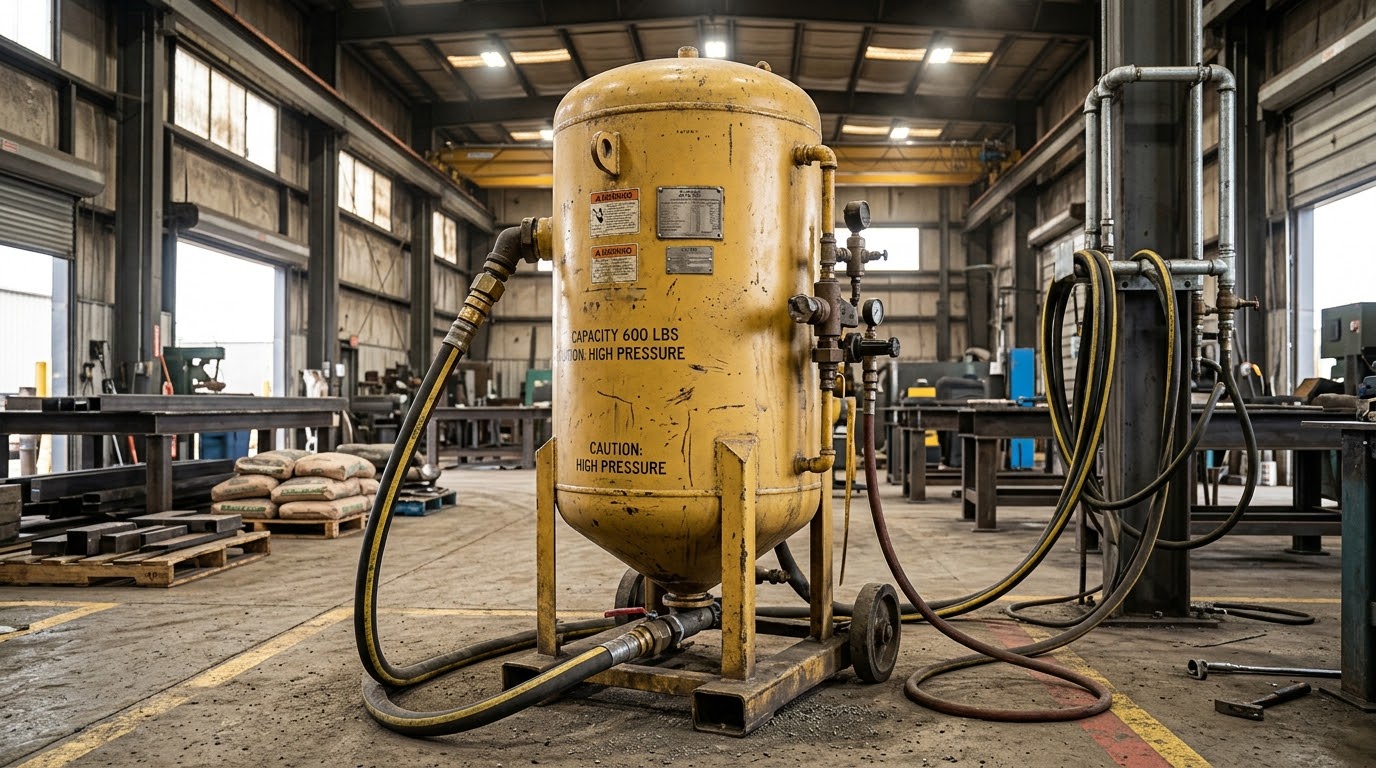
A 600 pound blast pot is a high-capacity industrial pressure vessel designed to deliver extended abrasive blasting runs without the constant downtime required to refill smaller units. Choosing this size changes your workflow, your compressor requirements, and your production output.
Smaller pots have their place in quick touch-up work or mobile repair trucks. When you manage large structural steel, heavy equipment frames, or continuous production lines, a small pot creates a bottleneck. Operators spend more time stopping, depressurizing, filling, and re-pressurizing than actual blasting. A heavy-capacity machine solves that inefficiency.
Understanding Abrasive Capacity and Weight
Weight ratings on blast equipment refer to the dry weight capacity of standard abrasive media, usually calculated around [lbs per cubic foot for materials like garnet, aluminum oxide, or slag. A 600 pound blast pot gives you roughly] cubic feet of usable volume.
Different media types pack differently. Steel grit is significantly heavier than glass beads or organic media. If you fill a 600 lb rated vessel with a very dense media, you might reach the weight limit before hitting the volumetric fill line. Always check your media bulk density before dumping bags into the hopper. Overfilling blocks the pop-up valve seal and prevents proper pressurization.
Operational Advantages of Large Blast Pots
Production speed dictates profit margins in commercial abrasive blasting. Stopping to reload a 100-pound pot six times an hour kills momentum.
- Reduced downtime: Operators maintain a steady rhythm, keeping surfaces at a uniform profile.
- Lower labor overhead: Less time spent cycling pressure valves means more productive nozzle-on-the-object time.
- Consistent pressure: Large-volume tanks handle air surges better, stabilizing media flow through the mixing valve.
Maintaining these systems requires proper hardware. For instance, matching your vessel to the right lid for a 6.5 cubic foot blast pot ensures an airtight seal during every pressurization cycle.
Air Supply and Plumbing Requirements
A massive tank demands massive airflow. Feeding a 600 pound blast pot with an undersized compressor defeats the purpose of having high media capacity. You need a steady volume of dry, compressed air to maintain pressure behind six hundred pounds of abrasive.
Most operations running pots of this scale utilize trailer-mounted industrial compressors or stationary rotary screw systems. Ensure your moisture separators and bulk air dryers are rated for the total CFM output. Humidity mixed with six hundred pounds of abrasive creates concrete-like clogs in the bottom head pipe.
Maintenance and Safety Protocols
Pressure vessels demand strict adherence to safety guidelines. Operating a vessel holding hundreds of pounds of abrasive under \[BRACKETED] PSI of working pressure means daily inspections are non-negotiable.
Check the pop-up valve gasket, remote control lines, and deadman switch before every shift. Look for internal wear in the abrasive mixing valve where high-velocity grit chews through metal over time. If you operate your equipment inside an enclosed environment like an abrasive blast room, dust collection and ventilation systems must handle the extended run times that a large pot facilitates.
Alternatives
When a 600 pound blast pot exceeds your spatial constraints or airflow limits, several alternatives exist for industrial surface preparation.
Smaller 150 to 300 pound portable pots offer easier mobility around cramped job sites or confined shop floors. Conversely, automated wheel blast systems eliminate compressed air and media pots entirely by using centrifugal blast wheels to propel steel abrasives against components.
Comparison
| Feature | 150-lb Portable Pot | 600-Lb Industrial Pot | Automated Blast Room |
|---|---|---|---|
| Primary Use | Spot repairs, small parts | Structural steel, heavy frames | High-volume production lines |
| Operator Count | Single operator | Single or dual operator | Automated / operator monitored |
| Mobility | High (job site friendly) | Low (stationary or skid) | Fixed installation |
| Refill Frequency | High | Low | Continuous feed systems |
Frequently Asked Questions
How much abrasive media does a 600 pound blast pot hold?
A 600 pound blast pot holds approximately 600 pounds of standard abrasive media like garnet or coal slag, though actual volume capacity varies based on the specific bulk density of the media you select.
What size air compressor do you need to run a 600 lb blast pot?
Running a high-production blast pot efficiently typically requires an industrial compressor delivering at least [CFM at 100 PSI], depending on your nozzle size.
How long will a 600 pound load of abrasive last during continuous blasting?
A 600 pound load generally lasts between 30 to 45 minutes of continuous trigger time with a standard #5 or #6 nozzle, assuming normal operating pressure and media flow rates.
Can a single operator maneuver a 600 pound blast pot easily?
Due to its heavy weight and large footprint, a fully loaded 600 pound blast pot is designed for stationary shop use or skid mounting rather than frequent manual relocation around a job site.
Upgrading Your Blasting Setup
Scaling up your operation requires reliable hardware built to withstand harsh industrial environments. JH Norton provides heavy-duty equipment, replacement parts, and expert guidance to keep your production line running without interruption. Contact our team today to find the right abrasive delivery system for your facility.
