


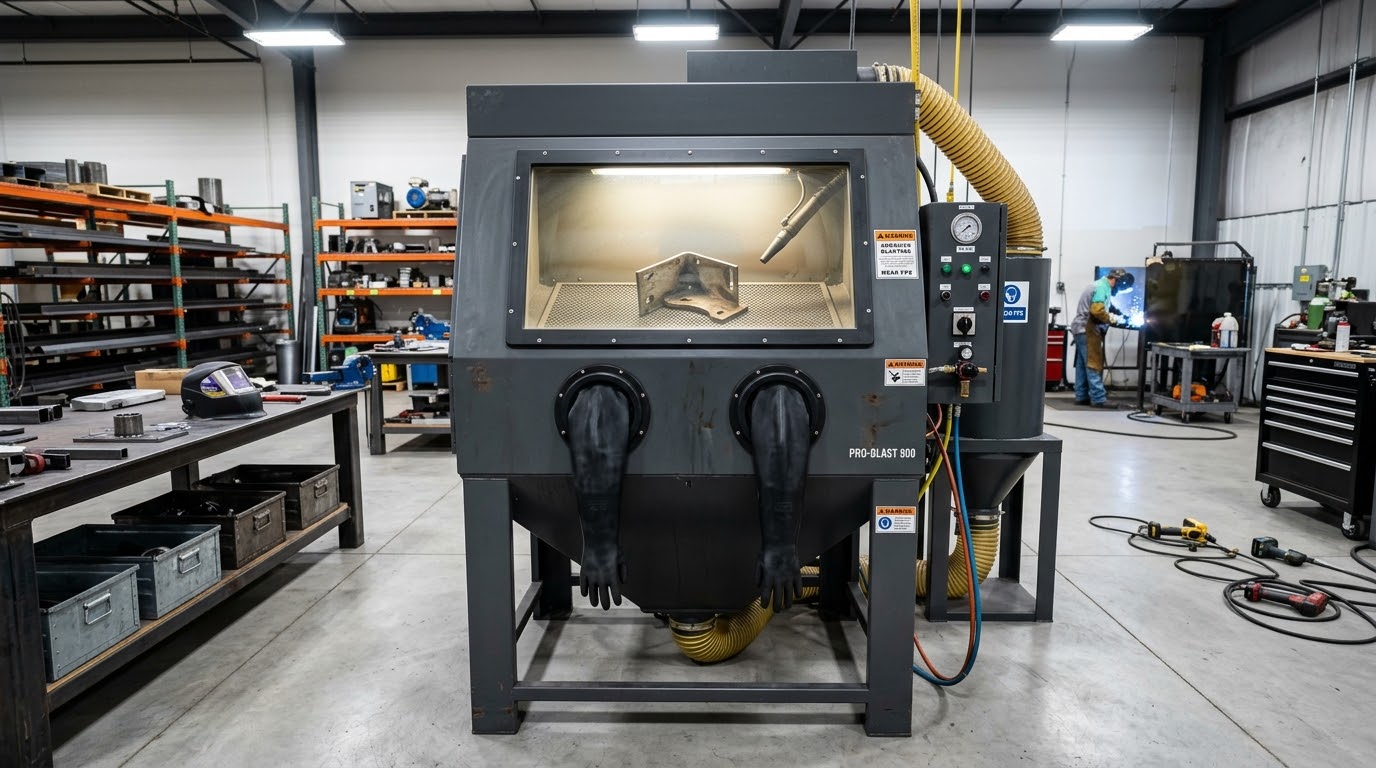
Blast cabinets provide a controlled, self-contained environment for surface preparation, cleaning, and finishing parts without contaminating the surrounding shop floor. Selecting the right unit requires matching your production volume, part geometry, and airflow requirements to the correct delivery system and cabinet dimensions. Shops dealing with heavy rust, thick coatings, or high-throughput manufacturing need a deep understanding of internal mechanics to avoid bottlenecks.
Investing in closed-loop abrasive processing saves labor hours and protects operators from airborne particulate hazards. Operations vary from light-duty tool cleaning to multi-shift aerospace component etching. This guide breaks down sizing strategies, delivery mechanics, and media choices so you can specify the ideal equipment for your facility.
Suction vs. Pressure Delivery Systems
The delivery method dictates your cleaning speed and air consumption. Getting this wrong leads to either sluggish production rates or compressor starvation.
Suction systems use a venturi nozzle setup. High-velocity compressed air creates a vacuum at the blast gun, drawing media up from a hopper and mixing it into the airstream.
- Suction Pros:Lower initial investment, easier maintenance, and excellent for light deburring, cosmetic finishing, and removing light surface rust.
- Suction Cons:Slower processing speeds because the media travels at lower velocities.
Pressure systems store abrasive in an ASME-coded pressure vessel beneath the cabinet. When the operator steps on the foot pedal, the vessel pressurizes, forcing a dense, high-energy mixture of air and media directly to the nozzle.
- Pressure Pros:Stripping speeds run up to four times faster than suction systems. The high kinetic energy cuts through heavy mill scale, thick paint, and tough coatings with ease.
- Pressure Cons:Higher initial equipment cost and increased media consumption rates that require robust recycling reclamation equipment.
Sizing and Ergonomics for Production Environments
Cabinet dimensions determine what you can process efficiently. Sizing isn’t just about fitting the part through the door; it is about giving the operator room to articulate the blast gun at the correct standoff distance.
Standard manual cabinets range from benchtop units for small fasteners to large walk-in styles. For most industrial applications, floor-standing models with large side-loading doors offer the best versatility. If your components require a forklift or hoist to load, look for robust grating and reinforced hoppers that can support heavy point loads.
Operator fatigue directly impacts finish quality. Ensure your chosen equipment features adjustable armports, high-intensity LED internal lighting, and foot-operated blast controls. A poorly lit cabinet leads to missed spots and over-blasted edges.
Abrasive Media Selection and Reclamation
The media does the actual work. Using the wrong abrasive ruins substrates or destroys your cabinet internals prematurely.
- Aluminum Oxide:Hard and angular, this media cuts fast and creates a deep anchor pattern for paints and coatings. It works well in heavy-duty clemco blast cabinets where aggressive etching is required.
- Glass Bead:A spherical, soda-lime media that peens the surface rather than cutting it. It produces a clean, bright satin finish without removing base metal.
- Plastic Abrasive:Softer media designed to strip coatings off aluminum or composite substrates without pitting or dimensional alteration.
- Silicon Carbide:The hardest commonly used abrasive, reserved for extreme industrial tasks like hard chrome stripping and specialized ceramics.
Reclaim systems separate reusable media from dust, broken fines, and debris via cyclonic separators and air wash classifiers. Consistent particle size ensures uniform surface profiles and prevents nozzle clogging.
Dust Collection and Air Requirements
A blast cabinet is only as good as its dust collector. Without adequate cubic feet per minute (CFM) airflow, fine particulates obscure the operator’s view through the window and choke the media loop with debris.
Size your dust collector to provide complete air exchanges inside the cabinet volume multiple times per minute. Cartridge-style dust collectors with automatic pulse-cleaning mechanisms maintain consistent static pressure during long production runs. Never run a cabinet without verifying that your compressed air supply delivers clean, dry air at the manufacturer’s specified pressure and CFM ratings. Moisture in the air line causes media to clump, halting production instantly.
Alternatives
When parts exceed standard cabinet dimensions or feature complex internal geometries that media cannot reach effectively, alternative preparation methods become necessary.
- Abrasive Blast Rooms: For large fabrications, structural steel, or heavy machinery, walk-in blast rooms replace cabinets entirely, allowing operators to work directly on the item with heavy-duty blasting pots.
- Chemical Stripping: Submersion vats dissolve paints and coatings without mechanical impact, making them ideal for delicate heat exchangers or intricate assemblies that risk warping under high-pressure media streams.
- Laser Ablation: A non-contact, media-free method that vaporizes rust, oil, and paint using focused light energy, eliminating the need for dust collection and abrasive disposal.
Comparison
| Feature | Suction Blast Cabinets | Pressure Blast Cabinets | Abrasive Blast Rooms |
|---|---|---|---|
| Production Speed | Moderate | High (up to 4x faster) | Maximum |
| Initial Investment | Lower | Moderate to High | Significant |
| Part Size Limit | Manual-lift components | Heavy components via crane | Entire vehicles or large weldments |
| Air Consumption | Lower (CFM) | Higher (CFM) | Highest |
| Media Reclamation | Standard gravity or cyclonic | Heavy-duty cyclonic | Floor hopper screw conveyors |
Evaluating your shop’s output helps determine whether standard empire blast cabinets or larger industrial systems fit your operational workflow.
Conclusion
Choosing the right equipment for your facility requires balancing production speed, part dimensions, and utility requirements. Investing in robust pressure delivery systems and reliable dust collection saves operational downtime and keeps surface preparation consistent across every shift. When your throughput demands a transition from standard enclosures to a dedicated abrasive blast room, JH Norton provides the engineering expertise and equipment lineup to scale your operations effectively.
